LVP Flooring Installation
Flooring Expert & Author
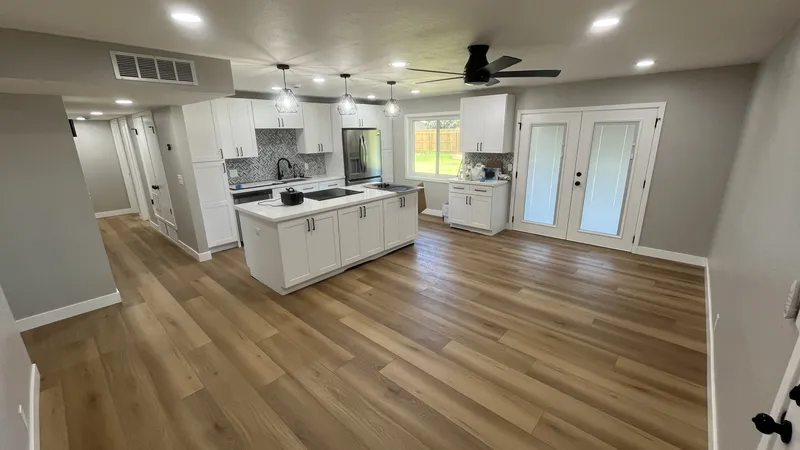
LVP flooring installation is the process of laying luxury vinyl plank over a clean, flat, dry subfloor. In a typical home it takes one to two days, and most of the quality comes from preparation, not from the planks themselves. This guide covers how LVP is installed, what the subfloor needs, what drives the cost, and when it makes sense to hire a professional. It is written for homeowners in Waukesha and across Southeast Wisconsin.
What LVP flooring installation involves
Luxury vinyl plank (LVP) is a plastic-based plank with a printed wood-look layer. Many versions have a rigid stone-plastic composite (SPC) core. There are two common ways to install it:
- **Floating (click-lock):** the planks lock together at the edges and rest on the subfloor without being glued down. This is the most common method in homes.
- **Glue-down:** the planks are bonded to the subfloor with adhesive. Some products are made for this method, and some commercial or high-moisture situations call for it.
Which method applies depends on the product you choose, so the manufacturer's installation guide decides it. Luxury vinyl plank installation and vinyl plank flooring installation both mean the same job, and the steps below apply to both.
The LVP installation process, step by step
- **Measure and plan the layout.** Planks are laid so the end seams are staggered and the last row is not a thin sliver along a wall.
- **Prepare the subfloor.** Remove old flooring if needed, clean the surface, repair damage, and check that the floor is flat and dry. This is the step that causes the most problems when it is skipped.
- **Set the room conditions.** The house should be heated and stable before, during and after installation.
- **Install underlayment if the product calls for it.** Some planks have a pad attached, and some need a separate underlayment. Follow the product instructions.
- **Lay the planks.** Work row by row, keeping the expansion gap the manufacturer specifies at walls and fixed objects, which the baseboard or trim then covers.
- **Cut around doorways, vents and corners, then add transitions and trim.**
- **Walk through the finished floor,** check the seams, and review care instructions.
Subfloor preparation matters most
A subfloor that is uneven, damaged or wet shows up in the finished floor. Flooring manufacturers set limits on how flat the subfloor must be. Flooret, which makes LVP and laminate, lists 3/16 inch over 10 feet for most of its products and a tighter limit for its herringbone LVP. To test it, lay a 10-foot straightedge on the floor. The gap underneath should stay at or under 3/16 inch at any point. Flooret's guidance is to fill low spots with a Portland cement-based patching compound or a self-leveling compound, and to sand or grind down high spots. Your product's installation guide sets the number for your floor.
Moisture matters too. Armstrong's installation guide for glue-down luxury vinyl tile says concrete substrates should be moisture tested before resilient flooring goes down, using either a moisture vapor emission rate (MVER) test or an in-situ relative humidity probe. If your floor is a basement slab, testing comes before flooring. If the floor is uneven over a wide area, self-leveling underlayment is usually the practical fix, which is covered in our guide to self leveling concrete.
Temperature and room conditions
Vinyl products have temperature rules. Armstrong's guide says the room, the flooring and the adhesives should be held at a minimum of 65°F for 48 hours before installation, during installation and for 48 hours after, and that the temperature should never fall below 55°F during the life of the floor. That is one manufacturer's guide for one product type, so follow the instructions for the floor you buy. In a Wisconsin winter, it is one reason the heating should be running and the house should be stable before the planks go down.
Is LVP waterproof?
Many LVP products are sold as waterproof, but the claim has limits. Paul Hambidge of Factory Direct Flooring notes that waterproof and water resistant are not the same thing, and that the usual industry test, pouring water on the clicked joints for 24 hours, does not match a real flood or a slow hidden leak. Ask the manufacturer what its waterproof claim covers. In practice, rigid-core LVP is a good fit for entryways, laundry rooms, basements and kitchens, where spills and melted snow are routine.
LVP flooring installation cost
The cost to install LVP flooring depends on the size of the area, the product you choose, what has to happen to the subfloor first, and how much cutting and trim work the rooms need. The main things that change a price:
- **The planks:** product grade and thickness vary widely.
- **Subfloor work:** leveling, repairs or moisture control add labor and material.
- **Removal of old flooring:** tearing out carpet, tile or vinyl takes time.
- **Room layout:** stairs, closets, angles and many doorways take longer than an open rectangle.
- **Trim and transitions:** baseboards, shoe molding and thresholds are often part of the job.
A written estimate after an in-home look is the only way to get a firm LVP installation cost, because the subfloor condition cannot be known from a phone call. Our estimates are free.
How long does LVP installation take?
According to our FAQ, most residential LVP or laminate installations take 1 to 2 days, depending on square footage and subfloor prep. Subfloor work, large areas and stairs add time. Your written estimate gives the timeline for your job.
DIY or professional LVP installation?
A simple rectangular room on a flat, dry subfloor is a reasonable DIY project if you follow the manufacturer's guide closely. Hire a professional when:
- The subfloor is uneven, damaged or on a basement slab with a moisture question.
- The area is large, or the layout has stairs, many doorways or odd angles.
- You want the work covered by a workmanship warranty. Illustrious Flooring's work carries a 5-year workmanship warranty.
- The floor must be installed in winter and the room conditions have to be controlled.
Skipping subfloor preparation is the most common reason a DIY floor develops gaps, flexing or separating seams later.
LVP flooring installation in Waukesha, WI
Illustrious Flooring installs LVP for homeowners in Waukesha, Oconomowoc, Brookfield and across Southeast Wisconsin. Kyle Hedin is a Certified Flooring Installer (CFI #17580) through the International Certified Floorcovering Installers Association. The work includes subfloor inspection, repair and leveling before the planks go down, so the floor is installed on a surface that is ready for it. Call (262) 683-5301, Monday to Friday, 9 AM to 5 PM, or request a free in-home estimate and we will check your floor and tell you what it needs. If you are comparing materials, see our guide to LVP vs. laminate vs. hardwood.
Questions about LVP flooring installation
Does LVP have to be acclimated before installation?
It depends on the product. Some manufacturers require the planks to sit in the room before installation, and some do not. Check the installation guide that comes with your floor, and keep the room at the required temperature.
Can LVP be installed over existing flooring?
Sometimes. The existing floor has to be flat, solid and clean, and the manufacturer's guide has to allow it. Soft, damaged or uneven existing floors usually have to come out or be leveled first.
Can LVP be installed over a concrete slab?
Yes, after the slab has been moisture tested and checked for flatness. Rigid-core LVP is a common choice for basements for that reason.
Do I need underlayment for LVP?
Some LVP has a pad attached to the back, and some does not. Whether a separate underlayment is needed, allowed or prohibited is stated in the product's installation guide.
Sources
- How Flat Does My Subfloor Need to Be? - Flooret support page, flatness requirements and low-spot repair guidance.
- Luxury Vinyl Tile Installation System (glue-down) installation guide - Armstrong Flooring, PDF created March 25, 2021, temperature requirements and concrete moisture testing.
- The Waterproof Laminate Myth: Why Consumer Expectations May Never Be Met - Paul Hambidge, Factory Direct Flooring, reprinted from Floor Trends Mag, April 24.
Kyle Hedin is the founder of Illustrious Flooring in Wales, Wisconsin, specializing in high-quality hardwood, LVP, and laminate flooring installations. With over 10 years of experience in the flooring industry, Kyle brings expert craftsmanship and a keen eye for detail to every project in Waukesha County and Southeast Wisconsin. His commitment to clear communication and client satisfaction sets Illustrious Flooring apart.
Related Flooring Services
Serving Waukesha, Brookfield, Oconomowoc, New Berlin, Menomonee Falls & SE Wisconsin.
Planning a Flooring Upgrade?
Get a clear, honest quote from Illustrious Flooring.